Sequence-based sUper-Resolution Framework
UT Southwestern · University of Chicago
Explore predictions
Chr8 with three signal tracks: low-coverage input, SURF prediction, and high-coverage experiment (not used for training).
Recover high-coverage prediction from low-coverage data
SURF turns sparse genomic measurements into higher-resolution predictions that more closely match held-out reads across coverage levels, resolutions, assays, and cell types.
Cell-type-specific signal preservationInput data vs SURF prediction
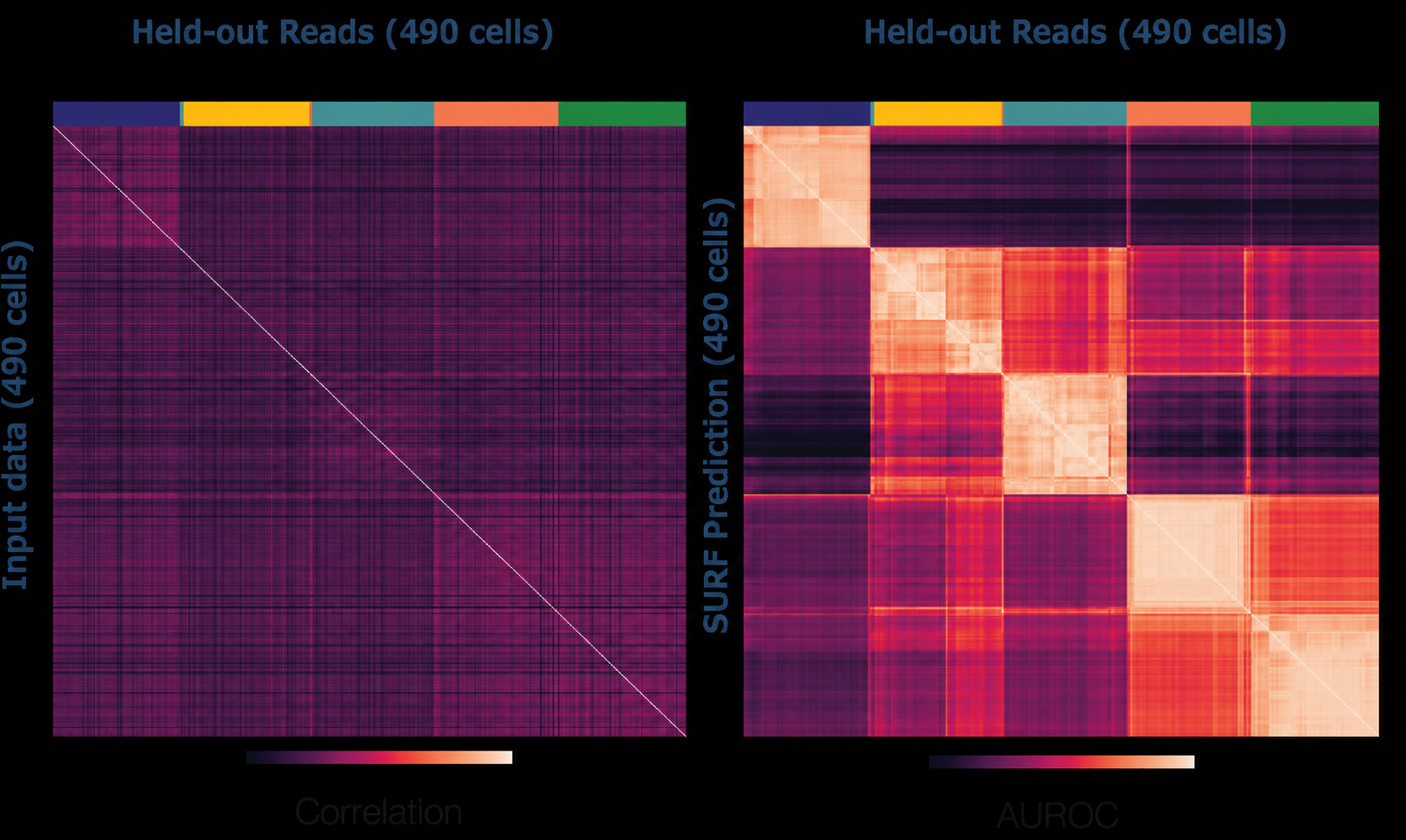
Across assaysSpecific held-out performance
DNase-seq0.77 data-only · 0.65 sequence-onlyBoth ablations trail full SURF at 0.89 on the 5% kidney benchmark.
CAGE+30% correlation vs input0.72 SURF vs 0.55 input across five cell types on held-out chr8, chr9, and chr10.
snmC-seq2+30% single-cell correlation5 kb-binned Spearman correlation against pseudobulks from 6,983 held-out cells.
Allele-specific effects at low coverageAcross 1,387 variants, SURF reduced AF-MAE relative to the low-coverage input by ~33% at 1 read/donor and ~20% at 5 reads/donor. At a 5% false-sign rate and 2 reads/donor, SURF recovers ~68 additional known variants (of 777) over the low-coverage input.
Train SURF, calibrate with SCAN, interpret the results
Three practical paths from a first toy run to evidence-aware interpretation.
Guide
SURF your data
Train the toy model, then adapt SURF to new genomic data with the included Agent Skill.
Start the guide →GuideSCAN predictions
Calibrate prediction intervals with the SCAN repository’s Agent Skill.
Start the guide →GuideInterpreting results
Evaluate what SURF adds, read SCAN intervals, and decide what deserves follow-up.
Start the guide →Repositories
Model, calibration, and analysis.
Training
SURF
jzhoulab/SURFToy DNase training and guided model development.
Train the reference model, then use the develop and predict Agent Skills to adapt SURF to new genomic data and export BigWig predictions.
Open on GitHub ↗CalibrationSCAN
jzhoulab/SCANSpline-based calibration for genomic profile predictions.
Fit calibrated intervals on held-out SURF tracks; the Agent Skill guides setup, diagnostics, and evaluation on a separate genomic region.
Open on GitHub ↗ReproducibilitySURF-manuscript
jzhoulab/SURF-manuscriptFull training code and figure notebooks for the SURF paper.
Reproduce every manuscript benchmark, analysis, and figure across DNase-seq, CAGE, and methylation.
Open on GitHub ↗Citation
Cite the work
The manuscript is still in preparation. Please cite the GitHub repositories for now; a preprint DOI will be added when it is available.
BibTeX
@article{avdeyev_surf_inprep,
  author  = {Avdeyev, Pavel and Chen, Kathleen and Zhou, Jian},
  title   = {Sequence-based super-resolution for genomic data},
  note    = {Manuscript in preparation},
  year    = {2026}
}